
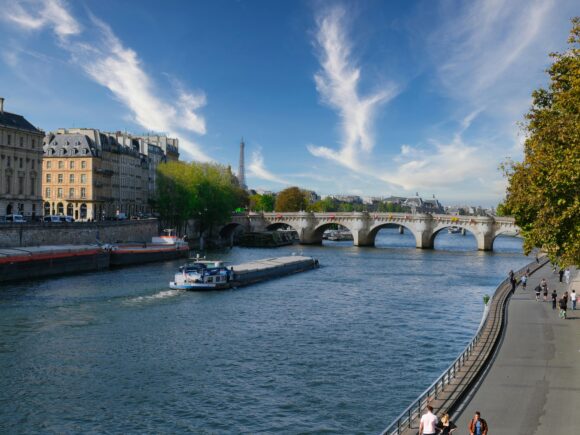
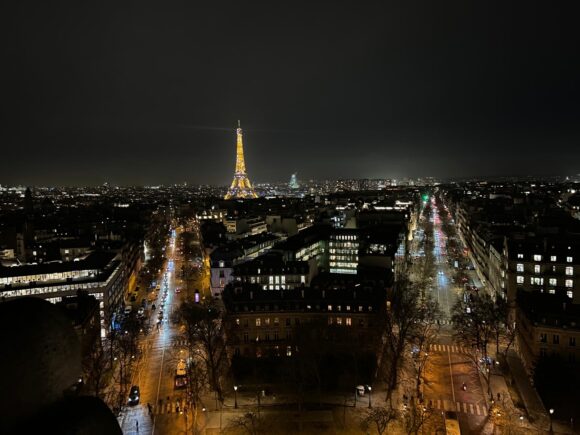
The mind seems to me like a museum unto itself, one made of lofty galleries and darkened corridors, displaying and hiding whatever we, its curators, decide to collect through life. It’s why souvenirs are called “keepsakes” in English rather than “discardables.” And so, today, whether I’m strolling through a park, drinking a latte at a café, or listening to my new colleagues conversing in their native tongue, I often find myself dusting off and admiring, if only for an instant, my favorite memories of Paris. For, they remind me of what I love about living.
“Madame Vauquer, née de Conflans, est une vieille femme qui, depuis quarante ans, tient à Paris une pension bourgeoise établie rue Neuve-Sainte-Geneviève, entre le quartier Latin et le faubourg Saint-Marcel. Cette pension, connue sous le nom de la maison Vauquer, admet également des hommes et des femmes, des jeunes gens et des vieillards, sans que jamais la médisance ait attaqué les mœurs de ce respectable établissement.” – the opening of Honoré de Balzac’s Le Père Goriot (1835)
 Recently, while browsing the Library’s inviting literature shelves, I picked up a book I haven’t encountered since the last millennium, in 1999. Balzac begins this episode of his comédie humaine—a 48 multi-volume collection of interlinked stories depicting French society from 1815 to 1848--with a lengthy, detailed description of the book’s primary setting. Rendered both plainly and truthfully by Balzac, La Maison Vauquer is a respectable yet affordable boarding house open to everyone. It is precisely the kind of place that was once common in the world, but which today seems to be disappearing. To me, Balzac’s bourgeois Parisian pension is not only a romantic relic of the past, but also a sobering portent of the future, in that it predicts tragedy for those, like Old Father Goriot, who struggle just to get by in an expensive city.
 Reading Le Père Goriot as a student on a budget allowed me to relate strongly to the character of Eugène Rastignac—an ambitious young man of noble, albeit poor, descent who is naive about Parisian high society. I remember myself in Paris returning time and again to the Musée Rodin, to view his remarkably vivid, lifelike, and beautiful sculptures. Among my favorites, of course, was Rodin’s monumental bronze casting of a heroic Balzac, looming over the spectator, wrapped entirely in a theatrical dressing gown or cloak. To me, it captures the essence of the novelist’s great stature, due largely to his prolific way with words. Like The Thinker and The Kiss (two of my other favorite sculptures by Rodin), Balzac’s work, too, grows deeper the more time you spend with it. These are works of art meant to be savored, absorbed, and then cherished forever. What other than Beauty will find a home in you?
 “How wonderful,” I remember thinking, “that a middle-class writer who told simple stories of entirely ordinary people would go on to be immortalized in such a way!” Some cities are so proud of their poets that they commission statues of them—art begets art. The special power of literature to lodge itself into the halls of memory is, perhaps like the taste of Proust’s madeleine, uncanny. As a young person studying Paris itself, I learned how to love the beautiful aspects of life. My sincere hope is that The French Library provides you, Dear Readers, with the same access to your own memories, regardless of what you decided to collect on the way here.

Jeffrey Rufo
Education Administrator
Jeff has spent fourteen years working in education, as a teacher and as an administrator. He began studying French in 6th grade, falling in love with both the language and the culture at an early age. With a doctorate in comparative literature from The University of Chicago, Jeff has published several academic articles on drama (especially Shakespeare and his French contemporaries). He is delighted to have the chance to finally work and live in Boston, where he was born. Besides reading, Jeff enjoys philosophizing, drinking coffee, playing music on the guitar (folk, blues, and jazz), thinking deeply about chess, and of course being in nature whenever possible.



I loved reading this . I was also a young American expat once that enjoyed reading Balzac